Home studios have a funny way of exposing weak links. You buy a decent microphone, open your laptop, record one test take, and hear thin vocals, hiss, clipping, or delay that kills the mood. The Audient EVO 4 USB Audio Interface is getting attention because its current U.S. sale pricing pushes a serious starter recording box closer to casual-buy territory, with major retailers showing new units around the high-$140s at the time of checking. That matters for musicians, podcasters, streamers, voiceover beginners, and small creators who need cleaner sound without turning a bedroom desk into a control room.
The bigger story is not the discount alone. It is what you get at that price: two mic inputs, Smartgain level setting, loopback for computer audio, bus power, and a small shape that fits beside a laptop. For creators tracking deal news, gear drops, and creator tools through consumer product coverage, this is the kind of price shift that changes the buy-or-wait question. At under many common “starter kit” budgets, the EVO 4 starts to look less like a compromise and more like a smart first studio move.
Why This USB Audio Interface Price Drop Matters for Home Creators
A price drop only matters when the product was worth wanting before the discount. That is where this deal gets interesting. The Audient EVO 4 has been treated by many home creators as a step above the no-name black boxes that fill marketplace search pages. Audient positions the EVO 4 as a 2-in/2-out recording interface with two EVO mic preamps, Smartgain, loopback, and simple computer recording support, while major U.S. retailers have recently shown sale prices near $148 for new units.
Why the deal feels bigger than the dollar amount
A $20 or $30 drop does not sound dramatic in a world of phones, laptops, and cameras. In home recording, though, that gap can pay for the cable, stand, or pop filter that makes the first setup work. A beginner who planned to spend $100 on a bare-minimum interface may stretch a little when the next tier slips closer.
That is the real friction. Cheap gear is tempting, but it often costs you later in noise, driver headaches, weak monitoring, or missing features. The Audient EVO 4 answers a different question: how much can you remove from the beginner pain pile before the price stops feeling friendly?
A singer in Ohio recording demos after work does not need a rack of studio hardware. A podcast host in Texas does not need eight inputs for one guest call. They need clean speech, stable monitoring, and gain that does not punish them for being new. This home recording interface fits that use case with less fuss than many older boxes built for people who already know the rules.
The hidden value is saved time, not only saved money
The mildly surprising part is that Smartgain may be worth more to beginners than one more spec on a comparison chart. Audient describes Smartgain as a feature that listens and sets input levels for you, which is useful because gain staging is where many first recordings fall apart.
That does not mean the machine replaces judgment. You still need a fair mic distance. You still need to avoid yelling into a condenser two inches away. But it lowers the chance that your first take lands clipped, buried, or uneven.
There is also a confidence benefit. When your first recording sounds passable, you keep going. When it sounds broken, you start blaming the mic, the room, the software, or yourself. A low-cost interface that removes one early failure point can keep a new creator from quitting before the second session.
What the EVO 4 Actually Gives You at This Price
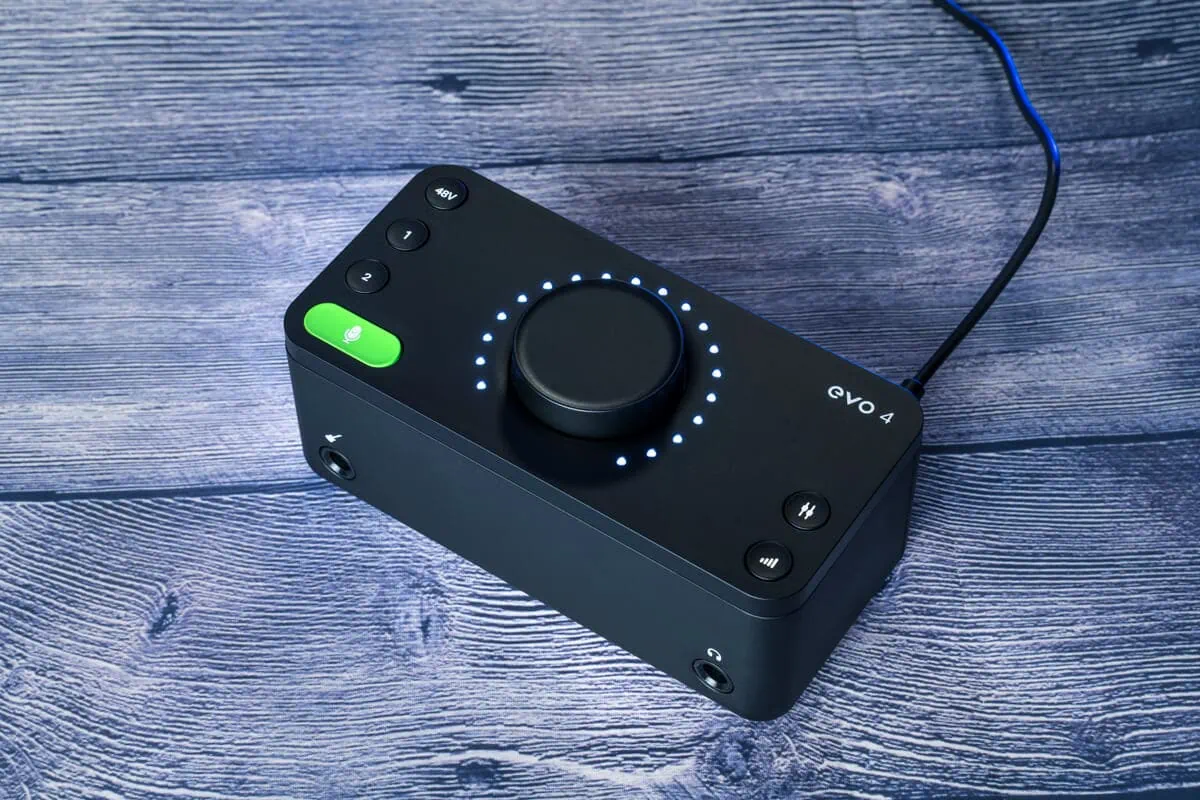
Once the discount gets your attention, the next question is simple: what sits on the desk? The Audient EVO 4 is small, dark, and plain in a way that makes sense. It does not try to look like a vintage console. It looks like a tool you can move between a dorm room, spare bedroom, kitchen table, or backpack.
Two inputs matter more than beginners expect
The two-input layout is one of the strongest reasons to consider the Audient EVO 4 instead of a single-input starter box. You may begin with one microphone, but needs grow fast. A guitarist wants to record voice and guitar. A podcast host wants a second local mic. A streamer wants a mic and instrument input for short music clips.
Buying one input can feel thrifty on day one and limiting by week three. That is the counterintuitive deal lesson here. The cheapest option is not always the one that saves money, because replacing it later turns the first purchase into clutter.
The EVO 4 has two combo mic/line inputs and a JFET instrument input, while retailer listings also point to 24-bit/96kHz recording, phantom power, monitor outputs, headphone output, and USB bus power. For a solo creator, that covers more ground than the size suggests.
Loopback turns it into a creator tool, not only a music tool
Loopback deserves more attention than it gets. It lets you capture computer audio along with your microphone, which matters for remote interviews, reaction clips, tutorial videos, gaming content, webinar repurposing, and podcast calls. Sweetwater highlights the EVO 4’s loopback use for mixing mic input with computer output, while reviewers have also called it useful for Discord, Skype-style calls, and content work.
That shifts the product out of the “musician only” corner. A creator in Florida recording a YouTube walkthrough can bring in laptop audio without building a maze of routing tricks. A teacher making paid lessons can record voice and app sound in one pass.
The quiet catch is that loopback adds power only when your content needs computer audio. If you only record one vocal into one track, it may sit unused. But when you need it, it saves the kind of setup time that makes people avoid recording at all. That makes it more than a spec. It is a workflow shortcut.
Who Should Buy Now and Who Should Hold Back
The sale makes the EVO 4 easier to recommend, but it is not the right choice for every desk. A good deal on the wrong box is still wrong. The better move is to match the interface to the way you record now, plus the next small step you are likely to take.
Best fit: solo creators who want cleaner sound without studio drama
The strongest buyer is the creator who has outgrown laptop audio or a USB mic but does not want a technical rabbit hole. That includes singer-songwriters, podcasters, streamers, online coaches, voiceover beginners, and small YouTube channels. The phrase audio interface for beginners fits here because the EVO 4 does not assume you already know how to set levels by ear.
A simple example: you plug in a dynamic mic, hit Smartgain, speak at your normal recording volume, and check the take. That flow beats twisting a gain knob while watching a meter you barely understand. It also helps keep your voice from jumping between episodes because you guessed differently each time.
This is where the EVO 4 deal feels practical. It is not chasing a fantasy studio. It helps you make the next piece of content sound cleaner than the last one. For many Americans working from apartments, spare bedrooms, or shared homes, that is the right target.
Skip it if your setup already needs more than two channels
Some people should pass, even at a tempting price. If you record a full drum kit, a four-person podcast in one room, or live sessions with several instruments, two inputs will feel small fast. Audient’s own line includes larger EVO models, and other brands sell bigger boxes for people who need more channels.
There is also the matter of physical control. The EVO 4 keeps the layout simple, with one main knob handling several jobs. Some users like that. Others prefer separate knobs for each input, each output, and headphone level. A deal cannot change your taste for hands-on control.
A mildly non-obvious point: beginners sometimes buy too much interface, not too little. Four or eight inputs look safer, but unused channels eat budget that could have gone toward room treatment, a better mic stand, or closed-back headphones. The best first rig is often smaller than pride wants and better than panic buys.
How to Judge the Lowest Price Without Getting Fooled
The title says lowest price, but smart shoppers should read that claim with care. Gear pricing shifts by retailer, stock status, bundles, open-box condition, rebates, and tax. A new unit at one store may appear higher than a used unit at another. A bundle may look cheaper until you notice it includes pieces you do not need.
Check new, open-box, and bundle pricing separately
At the time of checking, B&H showed the EVO 4 in stock at $148, while Sweetwater showed $148.45 with instant savings and a lower certified open-box option. Guitar Center’s deal listings showed a price drop around $161.99 in one result, while another product listing showed a higher standard price.
That spread tells you something useful. “Lowest” may depend on whether you mean new, open-box, used, local pickup, free shipping, tax, or bundled accessories. For a buyer in California, Texas, New York, or Georgia, the final checkout number can change after tax and shipping.
The clean buying rule is simple: compare the final cart, not the search-page price. Then decide whether the warranty and return policy are worth a few dollars. For recording gear, they often are. Driver issues, noise problems, or setup confusion tend to appear early, and a simple return path has value.
Avoid the fake bargain trap
The fake bargain trap starts when a product falls in price and you buy before asking whether it solves your actual problem. If your recordings sound bad because your room echoes, an interface will help less than a rug, curtains, closer mic placement, and quieter recording time. If your mic is the weak link, the interface will not turn it into a broadcast chain.
That does not weaken the deal. It makes the deal more honest. The EVO 4 can improve the signal path, give you better input control, add loopback, and support XLR microphones. It cannot fix a loud air conditioner, a desk that shakes, or a room with bare walls.
Pair it with the right basics. A decent dynamic mic for untreated rooms, closed-back headphones, an XLR cable that does not crackle, and a steady stand can make this podcast audio setup feel far more expensive than it is. For more publishing-side planning, you can pair gear decisions with creator content strategy and home studio buying guides once your site links are ready.
Conclusion
Good creator gear does not need to feel intimidating. The best tools often disappear after setup and let you focus on the take, the guest, the song, or the lesson. That is why this price drop lands well. It brings a respected little recording box closer to the budget range where beginners stop hesitating and start building.
The Audient EVO 4 USB Audio Interface makes the most sense for people who want two inputs, cleaner recordings, loopback, and faster setup without paying for channels they may never touch. It is not magic, and it will not repair a noisy room. Still, when paired with a sensible mic and a quiet space, it can raise the floor of your sound fast.
Buy it for the work you will do this month, not the studio you hope to own someday. If the final cart stays near the current sale range and the return policy is solid, this is one of those rare starter upgrades that feels useful on the first recording and still earns its spot later.
Frequently Asked Questions
How much should I pay for the Audient EVO 4 on sale?
A strong U.S. sale price for a new unit sits around the high-$140 range based on recent major retailer listings. Open-box or used units may cost less, but compare warranty, return terms, shipping, and tax before calling any deal the winner.
Is the Audient EVO 4 good for podcasting?
Yes, it fits podcasting well for one or two local microphones. Loopback also helps when recording computer audio or remote calls. For a three- or four-person in-room show, choose an interface with more mic inputs.
Is the EVO 4 better than a USB microphone?
It can be better if you want to use XLR microphones, record two sources, control gain with more care, or upgrade gear over time. A USB mic is simpler, but an interface setup gives you more room to grow.
Does Smartgain replace manual gain setting?
No. Smartgain helps set a safe starting level, which is useful for beginners. You should still check your recording, keep a steady mic distance, and listen for clipping, noise, or uneven volume before recording a full session.
Can I use the Audient EVO 4 for streaming?
Yes, it works well for streaming setups that need a microphone, headphones, and computer audio routing. Loopback is the key feature for many streamers because it helps blend voice and system sound without extra hardware.
Is the EVO 4 enough for music recording at home?
It is enough for vocals, guitar, bass, synths, voiceover, beats, and simple two-source sessions. It is not the right choice for recording full drums or several musicians at once because it only gives you two main inputs.
What else do I need with the EVO 4?
Most buyers need an XLR microphone, XLR cable, closed-back headphones, and a stable mic stand. A pop filter or foam windscreen can help with speech and vocals. Room control matters too, even if that only means recording away from hard bare walls.
Should beginners buy the EVO 4 or a cheaper interface?
Beginners should buy the EVO 4 if the sale price fits and they value Smartgain, loopback, and two inputs. A cheaper box can work for simple recording, but missing features may become frustrating once you start making content often.